Sales: 0203 002 0710
Accounts: 0208 432 3002
Admin: 0208 432 6953


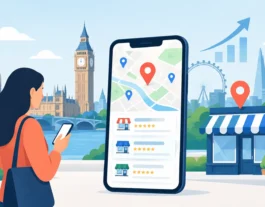
A customer whose boiler has failed, whose car needs an MOT or who needs an accountant rarely starts with a brand name. They search for a service, in a place, with a problem that needs solving. The future of local search marketing will be shaped by how well businesses answer that moment of need – clearly, credibly and faster than the competition.
For small and mid-sized UK businesses, local search is no longer just about appearing on a map. It is about proving that you are a genuine, capable local choice across Google, AI-powered search results, social platforms and your own website. The firms that treat their website, reputation and marketing data as connected parts of one lead-generation system will be in the strongest position.
Google has long used relevance, distance and prominence to decide which local businesses to show. Those principles are still useful, but the signals that support them are becoming broader. A complete business profile, accurate opening times, strong reviews and location-focused website content remain essential. Yet customers and search engines are also looking for evidence that a business is active, responsive and dependable.
That evidence can come from recent customer feedback, clear service information, up-to-date photographs, useful answers to common questions and a website that works properly on a mobile phone. It also comes from consistency. If one platform shows an old telephone number, another shows the wrong address and your website gives unclear service areas, confidence drops quickly.
This is good news for well-run local businesses. You do not need the largest advertising budget to compete. You need a credible digital presence that reflects the standard of service you provide offline. A well-maintained profile and a commercially focused website can outperform a larger competitor whose online information is neglected.
Customers are changing the way they search. Instead of typing a short phrase such as “roofer Chelmsford”, they increasingly ask fuller questions: “Who can repair a leaking flat roof near me this week?” Voice search and AI-assisted search are encouraging this behaviour, but it also reflects how people naturally make decisions.
Businesses should not respond by forcing long phrases into every page. The better approach is to make your website genuinely useful. Explain the services you provide, the areas you cover, the types of customer you help and what happens when someone gets in touch. Add clear answers to practical questions about availability, prices where appropriate, turnaround times, guarantees and next steps.
For example, a plumbing company does not need dozens of near-identical town pages with a place name swapped in. It needs well-written service pages, clear coverage information and local proof such as genuine reviews, case studies and project photographs. If it serves London, Essex and the home counties, that should be evident without making every page read like it was written for a search engine.
AI-generated answers may reduce clicks for simple questions, so the role of your site is shifting. It must give people a reason to choose you once they have found an answer elsewhere. Clear credentials, evidence of experience, helpful advice and an easy route to enquire all matter more.
Your Google Business Profile is often the first impression a local customer receives. It can display before they ever visit your website, particularly on a mobile search. Leaving it incomplete or treating it as a one-off setup means handing enquiries to businesses that are more visible and easier to contact.
Regular management should include checking categories, services, contact details, opening hours and service areas. Photos should represent the business as it is now, not as it looked several years ago. Posts and updates can be useful when they communicate something meaningful, such as seasonal availability, new services or local work completed.
Reviews deserve particular care. A steady flow of honest, recent reviews is more valuable than a sudden batch collected once a year. Ask satisfied customers at an appropriate point after the work is complete, and make the process straightforward. Respond to feedback professionally, including criticism. A considered response cannot erase a poor experience, but it can show prospective customers that you take service seriously.
There is a trade-off here. Chasing review volume without improving the customer experience is short-sighted. Five detailed reviews that explain why clients recommend you can be more persuasive than fifty vague star ratings.
Local rankings have little commercial value if visitors cannot quickly establish what you do or make contact. A future-ready local website needs to load quickly, work well on mobile devices and guide visitors towards a useful action – calling, requesting a quote, booking an appointment or completing an enquiry form.
The design matters, but it is not the whole job. Each important service should have a focused page that explains the problem it solves, the outcome customers can expect and why your business is a sensible choice. Contact options should be obvious. Forms should ask for enough information to qualify an enquiry, but not so much that people abandon them.
For location-based businesses, local relevance also needs to be built into the site structure. This might mean individual pages for genuine offices, areas with a substantial customer base or locally relevant services. It does not mean publishing thin pages for every postcode in the county. Search engines are increasingly capable of recognising content created solely to capture rankings.
Technical foundations remain part of the picture too. Secure hosting, reliable site performance, structured business information and accurate tracking help search engines understand your business and help you understand what marketing is producing leads. They are not glamorous, but they protect the investment you make in content, paid advertising and search engine optimisation.
The most effective local strategies will not rely on one channel alone. Organic local rankings can produce a dependable flow of enquiries over time, while Google Ads can place a business in front of high-intent customers more immediately. The right balance depends on your market, budget, service margins and how quickly you need leads.
A new business, for instance, may use paid search to generate early enquiries while building reviews and organic visibility. An established firm with strong local authority may use advertising more selectively for high-value services, busy periods or locations where competition is fierce. Neither route is automatic. Poor targeting can waste budget, and weak landing pages can make even well-managed campaigns underperform.
The key is to measure the outcomes that matter. Clicks and impressions are useful indicators, but they are not the end goal. Track calls, forms, bookings, qualified leads, sales and, where possible, the value of work won. This allows marketing decisions to be based on return rather than assumption.
Local customers increasingly compare businesses before making contact. They may check Google reviews, social media activity, photographs, company information and the quality of your website in a matter of minutes. Search visibility gets you considered; reputation gets you chosen.
That makes operational standards part of local marketing. Answering calls promptly, returning enquiries, arriving when promised and resolving issues fairly all influence what customers write and recommend. Digital marketing cannot compensate indefinitely for a poor customer journey. Equally, excellent service that is never reflected online is an opportunity missed.
Businesses should make it easier to capture their strongest proof. With permission, turn successful projects into short case studies. Use real images where possible. Explain the challenge, the work completed and the result. Specific evidence is more convincing than broad claims that you offer the best service.
The local search landscape will continue to change, especially as AI changes how results are presented. However, the fundamentals are remarkably stable: be easy to find, be clear about what you offer, demonstrate local credibility and make it simple to take the next step.
Avoid reacting to every new feature with a rushed content plan or a rebuilt website. Instead, review your local presence regularly, identify where enquiries are being lost and improve the areas with the clearest commercial impact. For some firms, that will mean better service pages. For others, it will be review generation, faster mobile performance or more accurate conversion tracking.
A dependable marketing partner can help join those pieces together, but the aim should always be practical: more of the right local customers, better-quality enquiries and a clearer view of what is delivering return. The businesses that keep their local presence accurate, useful and customer-focused will be ready when the next search change arrives.
